

Insurance and Paying for Therapy
Paying for therapy can be confusing, and we want to make it a little easier to understand your options.
Here you can learn more about the insurance plans we accept, our private pay rates, our approach to sliding scale, and some common health insurance terms.
Our goal is to give you clear information upfront so you can better understand what care may cost and what options are available to you. We are happy to answer questions and encourage you to call your insurance provider as well to make sure you understand your coverage.
Insurance We Accept
Interna accepts most commercial insurance plans.
Commercial insurance is health insurance you receive through an employer or purchase yourself. There are several types of commercial insurance plans, and each has different rules about which providers you can see and what you may pay for services.
We do not accept Medicare, Humana, Tricare, HealthEZ or EAP plans.
-
Minnesota Medical Assistance (MA)
UCare (We do not accept UCare Fairview Plans)
United Health Care
Medica
UMR
United Behavioral Health
Blue Cross Blue Shield (We do not accept Blue Plus Metro MN Plans)
Health Partners
CIGNA
Aetna
Harvard Pilgrim Health Care
Mayo Medical Plans
Gravie
Surest
Anthem
Prime West
South Country Health Alliance
Meritan Health
Carelon Behavioral Health
Private Pay
Interna offers and accepts private pay options.
Private pay means paying for therapy directly rather than using health insurance. Some folx choose private pay because they don’t have insurance coverage, their therapist or service isn’t covered by their plan, or they prefer not to use insurance for their care.
If you choose private pay, you’ll know the cost of your sessions upfront and can talk with your therapist about what frequency of care works for you and your budget.
If you are not using insurance, you have the right to receive a Good Faith Estimate explaining the expected cost of your care. We’ll provide this estimate so you have information about anticipated costs before receiving services.
Private Pay Rates
Diagnostic Assessment/Intake: $250
50-minute session: $225
45-minute session: $185
50-minute family therapy: $250
45-minute family therapy: $225
Extended Couples Sessions: $310
Comprehensive SUD Assessment: $375

Sliding Scale Rooted In Liberation and Mutual Care
The Green Bottle Method
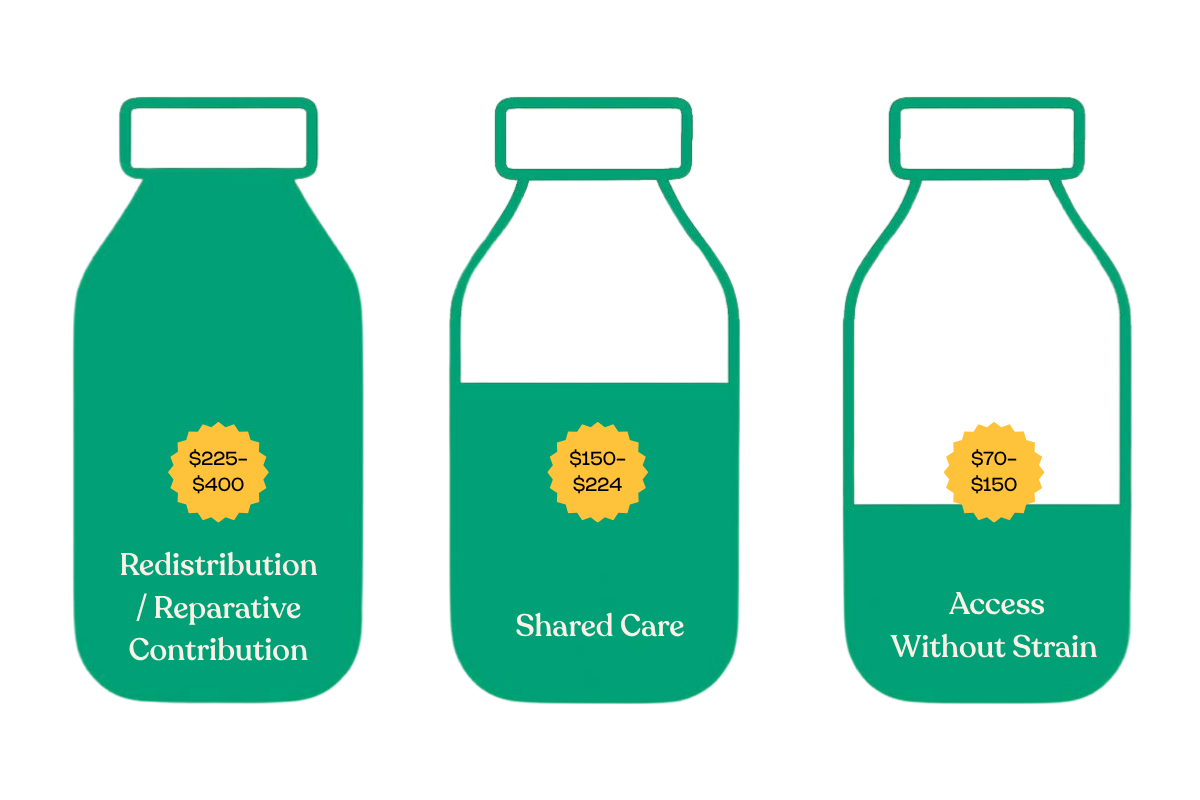
The Green Bottle Method is Interna’s approach to sliding scale pricing. We believe that access to therapy should not depend on wealth or productivity. Clients can self-select based on lived financial experience rather than income documentation. This model centers redistribution, access, and care for all.
Why We Use This Model
Traditional sliding scales rely on income alone and often ignore debt, disability, caregiving, medical costs, and systemic inequities. The Green Bottle Method centers lived experience instead of financial performance and treats care as a collective responsibility rather than an individual transaction.
How To Choose Your Bottle:
Each bottle represents a different way of participating in collective care. Financial access is shaped by systems, not personal success or failure. There is no better or worse bottle, and your choice can change as your circumstances change.
Choose the rate that feels right, and trust yourself in the process. You won’t be questioned about your choice.
-
This bottle is for people with relative financial safety, stability, or flexibility. You are generally able to meet basic needs without ongoing stress and may have access to savings, disposable income, or paid time off. Choosing this bottle actively supports redistribution by helping sustain the practice and expand access to care for others.
-
This bottle is for people navigating both access and pressure. You may meet many basic needs while still carrying debt, financial stress, or limited flexibility around healthcare, time off, or unexpected expenses. Choosing this bottle reflects participation in a shared-care model where access and sustainability are held together.
-
This bottle is for people whose access to money and resources has been constrained by systemic harm, instability, or ongoing financial stress. This may include difficulty meeting basic needs, housing or employment instability, lack of savings, or reliance on community or government support. Choosing this bottle prioritizes access to care without requiring financial strain or self-sacrifice.
Therapy Shouldn’t Be Out of Reach
We are opening a pro-bono waitlist for those who don’t have insurance coverage or for those with high-deductible plans over $3,500.
Submit a referral on our website, and we will pair you with someone for up to 10 sessions of therapy at no cost.
Health Insurance Terms
Health insurance comes with a lot of terminology that isn’t always explained clearly. Here are some of the terms you may come across when figuring out your coverage and what you might pay for therapy.
-
Health insurance helps cover the cost of healthcare, including mental health services. Depending on your specific plan, you may pay some of the cost through a deductible, copay, or coinsurance, while your insurance covers the rest.
Every insurance plan is different, so we always recommend checking your individual benefits to understand your coverage for mental health services.
-
Interna accepts Medical Assistance.
Medical Assistance (MA) is Minnesota’s Medicaid program, which provides health coverage to eligible Minnesotans. Eligibility depends on factors such as income, household size, age, disability status, and other circumstances.
If you have MA, your mental health services may have little or no out-of-pocket cost. Your exact coverage depends on your plan and the services you receive.
Key Features of Medical Assistance
No Monthly Premium: Enrollees do not pay a monthly fee to keep the coverage active.
Low Cost-Sharing: Members typically have very small or zero co-pays for approved medical services.
Comprehensive Care: Covers doctor visits, hospital stays, prescriptions, mental health services, and long-term support.
Income and Asset Rules: Eligibility depends on household size, income limits, and resource guidelines set by the state
-
Interna accepts most PMAP plans.
If you have Medical Assistance (MA), your coverage may be managed through a health insurance company. This is called a Prepaid Medical Assistance Plan, or PMAP.
Your PMAP covers services included with Medical Assistance, including mental health care. The specific providers, services, and benefits available to you depend on which PMAP you have.
Not sure which plan you have? Your insurance card should list the name of your health plan.
-
Interna does not accept medicare.
Medicare is a federal health insurance program in the United States. It provides medical coverage for people age 65 or older, as well as younger individuals who have long-term disabilities as defined by the federal government.
-
Interna does not accept Tricare.
TRICARE is the uniformed services health care program for active-duty service members, National Guard and Reserve members, military retirees, and their eligible family members worldwide. Managed by the Department of Defense's Defense Health Agency, it blends military health resources with a civilian network of medical professionals.
-
Interna accepts most commercial plans.
Commercial insurance is health insurance you receive through an employer or purchase yourself. There are several types of commercial insurance plans, and each has different rules about which providers you can see and what you may pay for services.
Common types of plans include:
HMO (Health Maintenance Organization): Generally requires you to use providers within your insurance network. Out-of-network services are typically not covered except in certain circumstances, such as emergencies.
PPO (Preferred Provider Organization): Usually gives you more flexibility to see both in-network and out-of-network providers, although you may pay more for out-of-network care. Referrals are generally not required.
EPO (Exclusive Provider Organization): Generally covers services only from in-network providers, but typically does not require referrals to see specialists.
POS (Point of Service): Combines features of HMO and PPO plans. You may be able to receive out-of-network care, but usually at a higher cost.
Even within the same insurance company, plans can be very different. Interna accepting an insurance company does not necessarily mean every plan offered by that company is in-network, so we recommend verifying your specific plan and benefits.
-
Insurance language can feel like another language Here are a few terms that can help you better understand what you may pay for therapy:
Premium: The amount you pay, usually monthly, to maintain your health insurance coverage.
Deductible: The amount you may need to pay for covered healthcare services before your insurance begins sharing the cost. Not all services or plans require you to meet your deductible first.
Coinsurance: A percentage of the cost you pay for a covered service, often after meeting your deductible. For example, if your coinsurance is 20%, you may be responsible for 20% of the allowed cost.
Copay: A set amount you pay for a covered service. For example, your plan may have a $30 copay for a therapy session.
Your deductible, copay, and coinsurance depend on your specific insurance plan, so two people with the same insurance company may have very different costs.